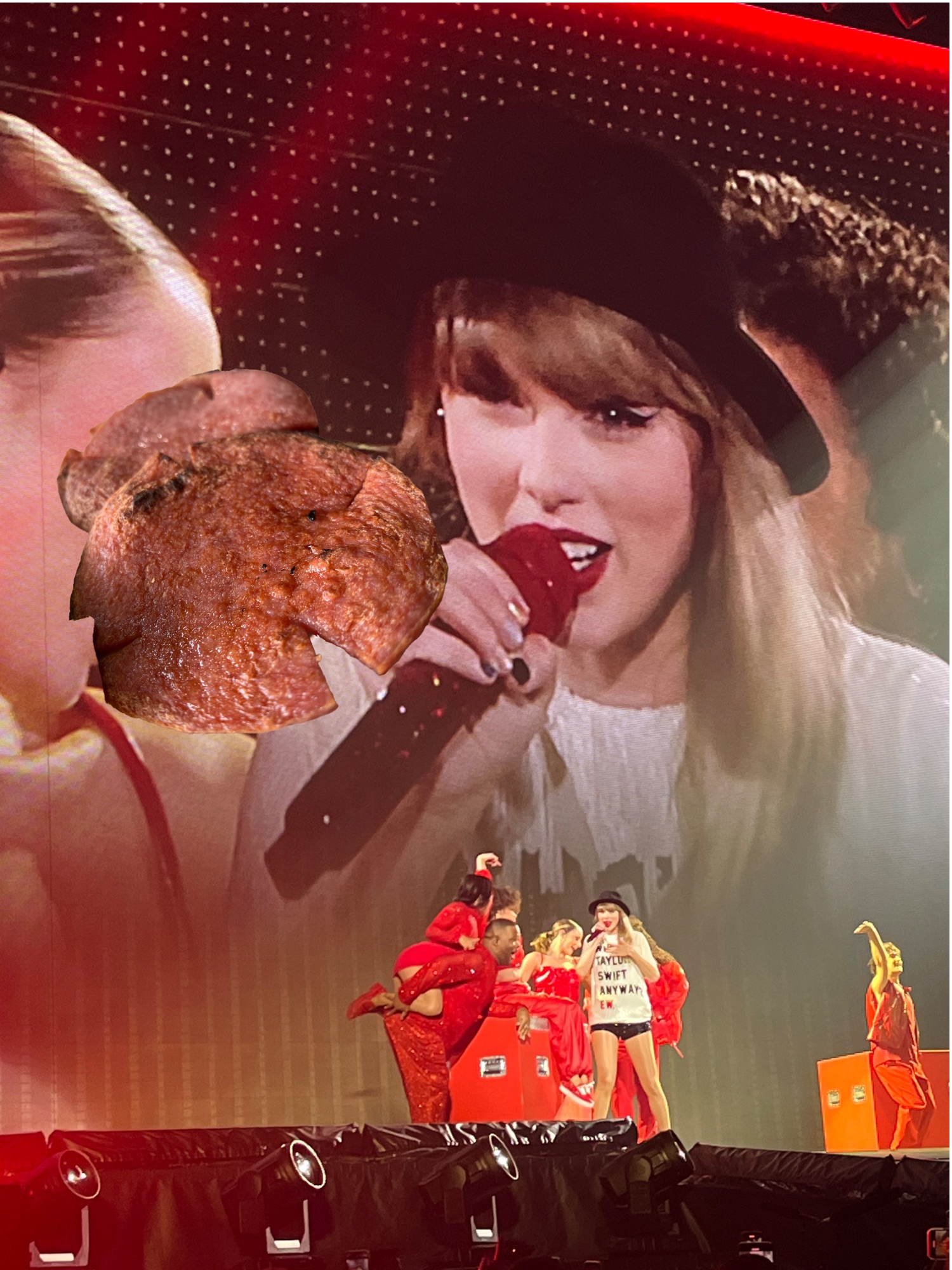
NB note: This essay is just shy of 9,000 words in length, meaning it could take you approximately 45 minutes to read. Thinking about your experience – the endless pings, the many tasks to complete, and the capacity to sit with a writer for nearly an hour on end – I’ve included headers throughout, as well as breadcrumbs between sections. If you’re compelled to take this adventure with me, please feel free to go as far as you like, stop at any header, and keep your web page open so you may return as you’re able to.
The first time I heard “Opalite” from The Life a Showgirl (hereafter, LOAS), I thought, “This is new.”
The song makes a sweeping, high-energy declaration: Life happens and even when it’s a bad thing, that’s a good thing.
I’d never thought I’d hear Taylor Swift, the self-proclaimed mastermind and authority on making karma work for you, belt out the phrase with her signature approach to the gut-punching bridge: “Failure brings you freedom.”
It made me think about the journey we’ve been on with Taylor throughout her career – the love stories, the fame misgivings, the personas, the clash, the realization, and now the arrival. It has been a metamorphosis. Hers is not a tale of existential dread as the well-known novella of the giant insect betrays. Instead, it is a magnificent narrative arc of existential stamina that she’s come to recognize and embrace.
So I thought back to when she drew a line in the sand in accelerating her path toward breaking free, and it occurred to me that Midnights felt like a huge departure from her prior work (as I wrote when I reviewed it upon release) both sonically and subject matter-wise. The album captures a self in flux – one who’s newly vulnerable and raw, casting a negative view on her own motivations and machinations, while seemingly at once certain this is the way it is and altogether unsure if that’s true. The album asks: What have I done to experience this?
Her next album, The Tortured Poets Department (henceforth, TTPD, and I’m referring to the full Anthology double-album), appeared to be a new phase in her arc of self-reflection and acceptance – with a thoroughly alienating sound, evoked through all the internal and never-ending rhyming, where she seemed to ask the questions: Is my experience within my control? And if not, is my birthright my birthwrong?
And now we have LOAS, which serves as the bookend of this journey, calling forth a confident, vulnerable, and real person who finally knows what she’s want – and, importantly, is willing to say so. There is no question posed by LOAS. Rather, it’s a declaration: I am fearless and I can be free now.
Taken together, the three albums – which I call Taylor’s album triptych, as you’ll soon discover – explore the constant negotiation between a double identity: The dutiful eyewitness of the human condition who makes every person, no matter who they are, feel seen and validated, and separately the real human behind the songs, the occasionally untidy, lovelorn person who may travel around the globe with a sourdough starter in tow, and is someone who, like you and me, simply wants to be free now – of judgment, including her own, and of strife – her way.
The tension calls to mind Margaret Atwood’s exploration of the writer’s identity as covered in her book on writing called Negotiating with the Dead. Atwood asks: Is it possible to travel through the looking glass admired and trundled through by Alice in Wonderland to merge the two selves – the eyewitness and the person behind the lens – and exist in the world? This question is at the heart of Taylor’s album triptych and she enables us to observe, up close and personal, her transformation from grasping caterpillar who wondered if this is all there is through the cocoon spanning one phase to the next in which her gestating self finds purpose and finally ending with the fearless butterfly, taking flight into the charging sky and available, at last, to finally be.
Allow me to be your guide through her journey, starting first with the importance of threes in art and for Taylor.
Three is a magic number
There’s a reason Schoolhouse Rock had the song “Three Is a Magic Number.”
I love threes. You love threes. Why? Because threes create the kind of patterns our brains cling to for meaning in the world around us. Three is easy enough for us to process while giving just enough information for us to understand.
Try this on.
Let’s say we’re talking about my favorite indulgences. I tell you about:
- The flakiest almond croissant I’ve ever had,
- The ultra-dark chocolate almond bark I made last week,
- The butter-drenched vanilla bean scone from my town bakery,
- The flash-fried tortilla chips I had at some Mexican place in the city, and
- The super-duper food salad with quinoa, black beans, sweet potatoes, and kale from a legendary café in my hometown
You internally scratch your head. You say, “Wow, that’s quite a list.”
You walk away.
But what if I stopped talking after the first three?
You might say:
- It sounds like you appreciate dynamic textures in your food,
- I also love butter, as you clearly do, and
- Would you be able to share the recipe for your dark chocolate bark because I can tell we have a shared sensibility about food?
The list of three items allowed you to draw meaning. And further, it drew us closer.
That’s why artists stick to threes. Because threes are sticky.
And we know Taylor loves threes. Just take a look at folklore, which covers a narrative told through three points of view in separate songs: “cardigan,” “august,” and “Betty.” (The narrative may perpetuate through songs elsewhere on folklore, like “exile,” “illicit affairs,” and “the 1.”) The love story she traces is one we know well, with the “Betty” character serving as the protagonist. Through these songs, we come to learn that Betty and James had a bright, bursting teenage relationship outlined with hallmarks in our collective unconscious, creating a visceral experience for the listener to witness (“Will you kiss me on the porch / In front of all your stupid friends?” and “Standin’ in your cardigan / Kissin’ in my car again”). At the same time, Betty comes to learn that James had a summer fling with another girl – as covered in the song “august” – where their covert trysts might take place in the suburban dreamscape of meeting behind the mall. In the song “cardigan,” positioned prior to the other two songs in the track list, we hear from “Betty” as she looks back on the love affair with James, realizing the profound and irreparable impact of the relationship and how she might move forward, imbuing a cinematic reel of a present-day scenes with sage reflections woven throughout (“To kiss in cars and downtown bars / Was all we needed / You drew stars around my scars / But now I’m bleedin’”). You’re left wondering: Will Betty and James make it after all?
Taylor’s approach of bringing to life and enriching a narrative across three points of view reminds me of Margaret Atwood’s novel, Life Before Man, which similarly calls upon her audience to fill in the gaps and engage meaningfully with the diverse, multi-faceted experience of the world as she moves the novel forward, cycling through three characters’ tales, an unusual love triangle at the center of the story. At the end of Life Before Man, you have to wonder: Will Lesje, the young ingenue who’s likely pregnant, make it with the older, searching male character, Nate? And what’s next for Elizabeth, the piercing wife we come to care for, in this landscape? You’re left with this feeling like: Is everyone going to be okay? And it stays with you, as you bring yourself into the participatory process Atwood facilitates through reading her novel.
This approach of weaving three points of view to create one rich narrative allows both Taylor and Atwood to delve into the complexity of the human condition, demonstrating that there are often multiple sides to every story, so that the reader feels a degree of empathy with these artists as our guides into the often messy, vulnerable experience of having perspective. The approach also asks the reader to participate in the process to bring their own life experiences to bear in understanding what, exactly, has happened and what’s yet to happen after the song and novel end.
Now that we have Midnights, TTPD, and LOAS, we can see that Taylor has taken the approach of enriching a narrative, diversifying perspective, and engaging her audience to feel empathy at the album level, which brings to mind the idea of the triptych, popularized by 20th century artist Francis Bacon. In his working life, Bacon painted 28 (known) triptychs – that is a story told in three images, left to right. Though often grotesque and unsettling, Bacon’s paintings prompted his viewers to reflect and explore, as they were presented with one urgent painting alongside two others, such as in his studies of the crucifixion.
As shown in Bacon’s work, the triptych asks the viewer to fill in the gaps between canvases: What happened between canvas A to canvas B to cause the change? What life experiences might explain the trajectory you behold? In this way, triptychs require an audience and create a symbiotic, participatory experience in understanding and appreciating the art. Without audience, there is no meaning – a central truism of the double identity experience Taylor has come to know well.
And why would I suggest a visual medium to convey what Taylor Swift, a songwriter, is doing?
Because her songs are films playing back to us, cinematic reels of our lives.
Consider your favorite book and why you love it so much. Let’s say it’s a love story and the protagonist is a woman. Over the course of the book, the writer paints a picture of this character. You see the petticoat she wears, the internal dialogue she negotiates within herself as the story unfolds, and the behavior other characters demonstrate toward her. Through these markers of what it is to be human – rather than “she was 25, living in the suburbs, with a broken heart” – you know this character. You see the world through her eyes. You taste what she tastes. And you begin to anticipate what she will say and do as the narrative arc takes shape. In this way, the writer has used a text-based medium to create a scene you immerse yourself in and relate to, wrapping it around you like a warm cloak. The page becomes the screen you watch in your mind’s eye.
Now, consider Taylor Swift’s songs. The way you’re drawn to them. How you exclaim when you hear her albums: Yes, this is me. I feel seen and validated. And how you screamed the bridge of “Cruel Summer” – with tears of joy bursting from your eyes, among a sea of 70,000 other people you do not know yet share this universally experienced moment of emotion – at the Eras Tour.
The way Taylor brings you in to her world is similar to the painter and the favorite author of yours who creates an entire world you wrap around yourself, so you may learn to live your life too. The sense of awe you experience as you bear witness is comforting, validating, and profound.
Let’s take a look at the way this happens in “All Too Well (10 Minute Version).” As a recap, “All Too Well” is a song about a love affair that may have appeared strong and promising on the surface, yet the sheen belied a tenuous, fraught experience destined to fail. The song maps a prospective story of a burgeoning love affair while simultaneously communicating the protagonist’s earned wisdom as she reflects on the wrongs done by her lover.
“All Too Well” is rife with textured details – like the keychain that says “fuck the patriarchy” being flung to the floor – and these details may not be ones you know in your own life. For example, how many people have such a keychain? Yet the “fuck the patriarchy” keychain illustrates the sensibility of the lover (a man); someone who advertises a feminist, progressive ideology on a quotidian commodity like a set of keys. And because you know this person – even if you don’t know this person – you are instantly with Taylor in the song, at ground zero of this love affair, which reels like a movie – rather than a generic confessional, for which there is a time and place – across the length of the song.
The “fuck the patriarchy” keychain is a small example in the context of a body of work containing hundreds (if not more) of similar details – so specific to be completely unrelatable, yet the effect is universal. You are embedded in the moment with her, in the scene of her life that reflects back yours because you can see it and she asks for your participation in the journey. And you listen through the 10-minute song and immediately start it over – countless times – to feel seen and feel something over and over again.
When Taylor told us she’s a “mirrorball” on folklore, she was right. No matter what you’re going through – what era of your life you may traverse, however you arrived and whenever you exit – there is a Taylor Swift song to capture the moment, the season of life, the meaning. It is all reflected back to you like a mirror of your life so you feel seen, validated, real.
She knows this is her express purpose and approaches it like a soldier heading into the battlefield. Yet at the same time, the question for her remains: How do I exist in this world as an eyewitness of the human condition and at the same time a person, like you and me, who experiences pain, who loves other people, who simply wants? And it is this question that set into motion the album triptych of Midnights, TTPD, and LOAS, which maps her trajectory through the looking glass that Alice in Wonderland passed through to meld the fantasy life, which for Taylor is having what you want and living fearlessly, and at the same time possessing the real-world experience of serving as a mirrorball of the human condition.
Throughout our exploration together, you’ll notice her language increasingly becomes straightforward, with LOAS reading like a simple wish list, as it were.
Let’s take a look at all of the facets of her experience that you may see yourself in, as you already do in her songs.
Can I be both?
You do not have to be a mega-popstar with stratospheric fame to feel like you have a double identity.
Think about who you are at work. Circumspect. Interested in weekend plans and the forecast. Exclamation points rife in your emails to communicate warmth and affinity.
With your friends and family, you may perform a different identity. Silly-faced and smiles when reading “Frog and Toad.” Interested in the latest lawn sign campaign in town. Short shorts and slogan tees dotting your weekend wardrobe.
You are the same person at work and home. But you’re not the same. And at times you may wonder: Could I be the same person in both worlds? Would I be happier, would I feel free if I could merge these two identities?
If this has ever crossed your mind, you, like millions of others, will see yourself in the arc Taylor paints for us across her album triptych as she explores her double identity – and how to cross the looking glass to merge the two.
We see this thread through the songs “Dear Reader” (Midnights) then to “Chloe or Sam or Sophia or Marcus” (TTPD) and ending with “Actually Romantic” (LOAS). All three songs focus on this dualness she faces: How can I be Taylor Swift™ and Taylor Swift at once?
With “Dear Reader,” the song reads like an advice column with sage gems like “if it feels like a trap, you’re already in one.” Yet the recurring pre-chorus is: “Never take advice from someone who’s falling apart.” There’s a sense that her self-conscious duty as being our trusted guide to the human condition – that reliable warm bath her fans slip into when they turn on her albums – is stark against the double self who is not so certain she has it together enough to have the life she wants.
This friction comes into focus on TTPD with “Chloe or Sam or Sophia or Marcus,” as she further reflects on her existential experience, whose most pointed line is: “You turned me into an idea of sorts.” She may change “into goddesses, villains and fools / Changed plans and lovers and outfits and rules” – in the same way she tried on and took off wardrobe throughout the Eras Tour show – and yet cannot feel confident any of these markers of what it is to be are working for her – or in advancing her ability to finally partner, as we’ll later explore. The most poignant – and central – lines of this song, conveying the flux she feels, now with the ability to name it, are: “If you want to break my cold, cold heart / Just say, ‘I loved you the way that you were.’” Who is she, who was she, and what will allow her to feel free and have what she wants? Can I ever win?
Moving through the album triptych, what we see on LOAS is someone who’s completely at ease with this unusual existence she has – the discrepancy between the role of eyewitness and the person who feels – which is well covered on “Actually Romantic,” whose opening verse goes: “I heard you call me ‘Boring Barbie’ when the coke’s got you brake / High-fived my ex and then you said you’re glad he ghosted me.” Here she conveys her experience as an “idea” (does the muse in “Actually Romantic” know Taylor Swift the person at all? Likely just “the brand”) and yet isn’t fighting it anymore, such as in finding ways to wield karma to her will, as covered in the next section – even finding the phenomenon kind of “cute.” Taylor likens the chants from the external world who judge her – with the song’s muse as the stand-in to represent the world at large – as “like a toy chihuahua barking out of a tiny purse / That’s how much it hurts.” As a newly evolved self, Taylor recognizes the problem here is them and even writes: “No man has ever loved me like you do.” She turns her everyday experience up to 11 and appreciates it, calling this experience “actually romantic,” which is in contrast to the almost-there-as-evolved-person-in-the-world “Thank You aiMee” track from TTPD (that also reads like a diss track, although it’s likely more nuanced).
On Midnights, she’s grasping for the problem. On TTPD, she puts it into words. And on LOAS, she tells us she accepts the perceived mismatch between fantasy and reality for what it is. And that’s because she feels at home in her self by the end of her journey.
But what got her to this place of having a dual identity in the first place? That’s where we go next through her album triptych.
Is my birthright my birthwrong?
When you think about your life, what role do your actions vs. fate or circumstance or the universe and powers that be play in its outcome? Untangling the provenance of your journey, the actions you’ve taken – were there choices you created? – and the path you’ve dug, can be vexing.
And for some people, understanding the why of how you got here can provide comfort and confidence in the how you move ahead – and, importantly, live the life you want.
So if you’ve ever wondered if the hand you’ve been dealt is a hand you can control, you will see yourself in this next phase of our journey through the album triptych.
Taylor has reckoned with this unusual path she’s been on for her entire career, and it was on Midnights that she began to explore what’s set her on this trajectory of two selves, noting she was not ready to look in the mirror to notice on “Anti-Hero” (“I’ll stare directly at the sun but never in the mirror”). She explored the ways she could dictate her path – that is bend the forces of the universe to conjure good things in her view – in songs like “Karma” and “Mastermind.” On TTPD, she wonders if her path has been determined by her own birthright, perhaps, in “The Prophecy” and “Who’s Afraid of Little Old Me?” By the time we get to LOAS, she’s ready to let go of shaping the will of the universe and headlong to simply own her own life as shown with “Wood.”
We’ve long known that Taylor identifies with the idea of karma – that is, what you put out into the world is what you get from the world – and she courts cautious confidence in “Karma,” depicting it as “a god,” “the breeze in my hair on the weekend,” and other markers of liberation, indicating she feels the need to put her faith in something to eventually merge her purpose and her desires. There’s a tinge of vengeance in her portrayal of karma – “I keep my side of the street clean / You wouldn’t know what I mean” – which suggests a level of self-consciousness, while also illuminating that she may see karma as something she can exercise control over (as she feels that her future may be out of her own control), showing the conflict she faces throughout Midnights: If I avoid the petty internet fight, I will receive good things in the world. And when others do harm in the world, they deserve what they get.
This inclination to control is evident on the song “Mastermind” from Midnights, whose subject is leveraging the machinations of the universe to bend to her will within the context of a romantic relationship (“And the touch of a hand lit the fuse / Of a chain reaction of countermoves / To assess the equation of you / Checkmate, I couldn’t lose.”)
With these songs alone, it’s evident that, for Taylor, she recognizes there may be forces outside her control that shape her world and she exercises as much control as possible to tailor those forces for her benefit – yet it raises the question: Is it really possible to shape your future?
Cycling through the album triptych, we approach TTPD and find a new shade of this subject where she appears to continue delving into the notion of why her life is what it is – and what she can do to create success as she grapples with the double identity she experiences.
TTPD explores her singular experience as Taylor Swift – a level of fame, celebrity, and fortune for which she has no peers and therefore no map to guide her (“You wouldn’t last an hour in the asylum where they raised me”) – and openly wonders if all of this has been a matter of birthright at this turn of her evolution, which cuts two ways. She focuses on this topic in two songs: “The Prophecy,” exploring her perceived lack of luck in love which may feel like destiny (“Please I’ve been on my knees / Change the prophecy / Don’t want money / Just someone who wants my company”), and “Who’s Afraid of Little Old Me?” which similarly covers a path that’s been beyond her control and focuses on her career (“I was tame, I was gentle ‘til the circus life made me mean”). We understand that, at this point in her journey of self-acceptance, she recognizes that the double identity she has may create inherent conflict – with significant upside in one arena and potential downside in another: Is what appears to be my birthright actually my birthwrong?
Keeping in step with the album triptych idea of mapping her journey, we see a new take on this topic on LOAS. “Wood” – whose chords call to mind “Superstition” by Stevie Wonder, an intentional strategy – circles on the topic of “knocking on wood” and otherwise conjuring outside forces to receive what you want most in the world. She openly admits “I’ve been a little superstitious” – calling upon keeping her side of the street clean a la “Karma” and the idea of seeking external devices to shape her fate, or disrupt the prophecy – and dispenses with these tactics, understanding that “you and me, we make our own luck,” saying “I ain’t gotta knock on wood” in the chorus. She’s realized, in this final step of her arrival, that she no longer needs these talismans she’s relied on before to have what she wants and feel free, since she now feels empowered to have a measure of influence over it in relationship with a like-minded partner – a topic of considerable interest in her body of work.
Will I ever partner?
You’re 15, walking the halls of your high school, passing notes to your friend in class, and playing out the next 15 years in your head: love, marriage, honeymoon, family. You move through the days – slow like sprinting through the ocean, the ever-turning tide pushing you backward as you strive to move ahead – wondering and hoping and dreaming of finding someone. Will it happen? Can it happen? When?
And then, all of a sudden, you’re 30, married now for going on three years, and think back to the seemingly never-ending phase of uncertainty of whether you’d ever find someone. You feel comforted by the chain of events that led you to your partner and the role you and the universe played. You understand that wanting and waiting may be part of life, and trusting the journey – and your ability to navigate it, whatever obstacles you may encounter – is an area of strength that buoys you for the unknown future ahead.
If you even have a passing knowledge of Taylor Swift’s music, you’ll find this familiar (love) story. Her contemplation of her role in her seeming lack of success with partnering is an area of interest across the album triptych, as alluded to in the above section. Let’s take the topic head on next, as she delves deeply into it: Will I ever partner? And, if so, in light of my double identity, how can that possibly happen?
Understanding the nature of her experience – that is having a singular one, traveling a road never traveled, being so famous with a billion people in the world wanting to know her every move, which has often been used as a cudgel against her in the past – thinking about how to partner, in a way where someone can be vulnerable, as most people are in intimate relationships, may present questions. Conflicts. Uncertainty. Danger even. And yet she yearns for it. And wonders: How?
Starting with Midnights, the album opens with “Lavender Haze,” asking us to meet her at midnight to set the stage for the album. What happens at midnight? She tells us everything – including her – changes then, in the song “Midnight Rain.” It is a moment of flux, and that’s exactly where she is in this caterpillar-like phase of her self trajectory, searching and wondering if this is all there is. Her lover can take or leave her experience in the self she possesses, never reading too much into her “melancholia,” although the listener has to wonder if this passive experience, one where the lover serves as a blank canvas for her, is serving her well. She doesn’t know, and it feels right – or as right as she can imagine – so she says she wants to stay in this “lavender haze” for the time being.
We get a glimpse of the nascent tension undulating like a beating heart throughout the album on the song “Labyrinth,” in which the recurring lines of the chorus are: “Uh oh, I’m falling in love.” She goes on to elaborate on the conflict – the risks presented in letting someone in, letting someone get too close – in the second verse, where she sings, using emphatic alliteration for further emphasis: “Break up, break free, break through, break down.” And this process of letting someone in – this sticky moment of searching and creating risk for yourself – is central to the triptych formed by this album.
We also see this conflict rear its head on “Bejeweled,” which covers a complex diversity of feelings, such as confidently denying her relationship (“They ask, “Do you have a man?” / I can still say, “I don’t remember”), openly saying her man actually doesn’t value her (“Don’t put me in the basement / When I want the penthouse of your heart”), and then asserts with what appears to be “fake it ‘til you make it” self-talk: “I polish up real, I polish up real nice.”
Is your head spinning yet? This is part of why Midnights is the opening for this journey of self-discovery for Taylor – she’s realized the conflict is deep and she’s going nowhere fast, she wants to know why, and she brings us through the morass of human messiness with her to ask: Have I arrived and this is what I get?
As evidenced elsewhere in this essay, we see an evolved take on this very topic in the middle album of the album triptych, TTPD, with the bridge of “The Smallest Man Who Ever Lived” representing the full force of this question of whether she’ll ever partner as this double identity self.
In the context of the album’s core premise – the singular experience of Taylor Swift – we see her reckoning of the double self in the song’s bridge, understood to be the full emotional vision of every Taylor Swift song (as covered in this examination of her and Gracie Abrams’s treatment of the bridge). In a rare experience of feeling unguarded – with a lover who may have felt like a twin flame, as explored elsewhere on TTPD – she spells out her fear: You saw me at my most vulnerable and the world will now know that, and hold it against me (“Were you writing a book? Were you a sleeper cell spy? / In fifty years from now, will all this be declassified?”). Worse yet, she realizes that though the risk for her is significant, nothing will happen to this (reckless) lover. “You kicked out the stage lights / But you’re still performing.” How can she ever let someone in and trust them when the stakes are so high? Is this birthright fame she experiences in direct conflict with having a relationship?
In step with the evolved self evident across LOAS, she includes the song “Elizabeth Taylor” as the second track of the album, demonstrating her gift for perspective as usual, now with a clear-eyed self steering the ship. Hollywood history tells us Elizabeth Taylor was the “It girl” before there was social media and high-lux ring lights and Botox to perform beauty in the world. She married eight times, and observers in real time may have wondered if any one of her husbands (seven as she married one man twice) wanted to be with Elizabeth Taylor the most beautiful woman in the world (the idea) or Elizabeth Taylor the person. (“Hey, what could you possibly get for the girl who has everything and nothing all at once? / Babe, I would trade the Cartier for someone to trust.”) At the same time, once these men got what they wanted, the immense weight of public scrutiny and perception may have scared them away, which may suggest the reasons they had for partnering with her in the first place lacked rigor (“All the right guys / Promised they’d stay / Under bright lights / They withered away”). It’s no surprise that Taylor – with her deft gift for empathy and understanding – calls upon this other well-known double to fully articulate her experience, tapping into a story understood in the collective unconscious, as we can see in the bridge. This searching, this yearn for trust – “Tell me for real / Do you think it’s forever?” – calls back upon the betrayal she felt in “The Smallest Man Who Ever Lived” asking: Can I be a real person in a real relationship at last and will I be safe? She references past lovers who may have been in it for the wrong reasons – “You’re only as hot as your last hit, baby” – and then reveals the soft raw center of her experience, and why she might take a leap of faith and trust someone at last, as a wholly formed self: “And I can’t have fun if I can’t have you.”
And yet we see the resolution of this experience in the first track of LOAS, “The Fate of Ophelia,” again positioned as the album opener like “Lavender Haze” as a declaration of her intent.
First, in the second full verse of the song, she sings: “And if you’d never come for me / I might have drowned in my melancholy,” citing the “melancholia” that the passive prior lover tenuously accepted a la “Lavender Haze” (or at least doth not protest too much). Then in the chorus, she sings, “It’s ‘bout to be the sleepless night / You’ve been dreaming of,” hearkening back yet again to Midnights. At the end of the song, we do not have a tragic tale, known well through Shakespeare’s tragedy, Hamlet, but rather one in which Taylor has turned a corner to invite a lover into her cocoon of protection and privacy to show her she can be truly vulnerable with them and experience partnership in a way that’s entirely new, so she no longer has to sit “in her tower” alone, feeling “no longer drowning and deceived,” and void of an engaging, human experience. It isn’t just the lover who’s done this, but we’ll come to find that, through her exploration of what makes her tick, it was a partnered endeavor – one in which she accepted being “dug out of her grave” – that has enabled her to flourish in a symbiotic relationship. As a result of letting her lover in, she’s turned the Shakespeare tragedy of Hamlet into a triumphant love story, with the happiest ending being her ability to break through her fears.
(For ultra fans: Please note, this is the second (direct) time Taylor has taken on Shakespeare and given it an ambitiously hopeful twist, with the first being “Love Story.”)
What makes me tick?
You’ve heard the phrase: You have to love yourself before you can love anyone else.
So you think about: How do I love myself, the good and the bad? What do I want? And how do I know what to want? Questions anyone may ask at some point in life, and important ones when also thinking through how to find a partner in life.
We see Taylor exploring the idea of what makes her tick in this album triptych too, and it’s an essential pillar of her overall journey toward self-discovery.
On Midnights, we have “You’re on Your Own Kid” – taking a caustic view of her provenance balanced out by the sage guide to the human condition we heard from in “Dear Reader.” On TTPD, we get a glimpse of the arrested development we’ve long seen her grapple with (see “Never Grow Up” as but one example) on “Peter,” as well as her searching heart in “I Look in People’s Windows.” Finally, to round out her arrival, we receive an explanation rooted in current psychological research, with “Eldest Daughter,” and an uncomplicated inventory of what she wants, once and for all, with “Wi$h Li$t.”
“You’re on Your Own Kid” features the central point of tension as seen elsewhere on Midnights, where she’s constantly questioning the external identity as Taylor Swift the knower of the human condition and mega pop star, against the internal experience of being human and behaving as such: “Summer went away, still, the yearning stays / I play it cool with the best of them.”
Like nearly every Taylor Swift song, and as mentioned, the bridge of this song is where she cuts deep to the heart of the matter, tracing back the wardrobes and behaviors she tried on in the past to merge her dual selves – ranging from “hosted parties and starved my body” through going along with the prevailing wisdom of the machine (a la “Who’s Afraid of Little Old Me?”) for the “money” she took. Raw and vulnerable as she is in this bridge – uncovering facets of her life not previously known – she snaps back into the wise guide her fans have come to love in the second half of it, dropping lyrical gems like “Everything you lose is a step you take,” which, in the context of the ever-flux of Midnights, summarizes the “fake it ‘til you make it” attitude she clearly pronounces in “I Can Do It with a Broken Heart” found on TTPD.
Which brings us to the central cocoon phase of her album triptych, where the narrative oscillates from grasping to naming, as shown in TTPD, as she digs deep for answers about life’s greatest questions, including what makes her do what she does and what she might want to do next.
In conjuring an explanation for why she is the way she is, the thread of arrested development – meaning a self who, for reasons likely outside her control, may have stumbled through the ordinary and expected experiences of “growing up” or perhaps never had them in the first place – has cropped up throughout her body of work (see “cardigan” where she references Peter Pan even there). On TTPD, we get “Peter,” about a Peter Pan-like lover, who is the twin flame that runs deep across the album. For Taylor, her Peter may have been the north star who guides her, who could even save her – “You said you were gonna grow up, then you were gonna come find me” – and by the end of the song, she recognizes that she doesn’t need her Peter after all (“‘Cause love’s never lost when perspective is earned”), demonstrating the pivotal growth at the heart of the album.
This brings her to realize one of the key questions she has about her motivations in life is: What should (do) I want?
“I Look in People’s Windows” from TTPD is an examination of her experience as the double – the writer with the sense of duty to witness the human condition at the top stratosphere of fame and celebrity within the context of a real person, perhaps someone who’s been developmentally arrested as covered on “Peter.” She conjures the question: If I’m supposed to have everything I want in life, what does that look like? And this song demonstrates her experience as covered throughout the short song with an unusual structure (no bridge): “So I look in people’s windows / Like I’m some deranged weirdo / I attend Christmas parties from outside.” It’s not just the “nice wine” these people drink – what “normal” people may do, positioned as a cue to her – but also seeing herself as an Other within the boundaries of a relationship, with the lover on the “inside” as she peers in as an interloper in life. We get the sense that her double identity self is so disorienting that she does need a guide – like the Peter she dispensed with – to focus on what it is she can or should want in life.
And yet on LOAS, as illustrated elsewhere, we see clarity in how she understands both herself and what she wants, at last.
“Eldest Daughter” helps to close the loop on this narrative and central question of how to be while navigating her double identity. She tells us up front in the first verse, demonstrating a notable turn in her evolution: “I have been afflicted by a terminal uniqueness / I’ve been dying just from trying to seem cool,” like the coolness she cites in “You’re on Your Own Kid.” A tone of acceptance and empowerment cuts deep in the meme-like language, which she appears to use as a foil to doing what’s right – like being “punk on the internet” – and ultimately declares, in spite of prevailing conduct: “But I’m not the baddest / And this isn’t savage / But I’m never gonna let you down / I’m never gonna leave you out.” She is saying: I live by my values and I’ll say it loud and clear, whatever the consequences may be.
Later on LOAS we get “Wi$h Li$t” that demonstrates her experience of letting go – of constructs, of judgment, and of finally allowing herself to want whatever it is she wants. The song covers a litany of what others want – whether it’s a contract with Real Madrid or an Oscar on their bathroom floor – all while passing no judgment of these desires (a contrast to the dagger-like point of view on songs like “Karma”), and the recurring chorus simply states: “I just want you.” We see her embedded in this experience of acknowledging what others want without reflecting on what she doesn’t have, an even hand distributing both sides to the listener, unlike in “I Look in People’s Windows” where she draws a stark contrast to the expected wants and needs of all people and what she lacks herself. She also writes her “wish list” in the simplest way, rather than leveraging an established narrative to do the work of telling the story for her to serve as a kind of proxy and shield from vulnerability as she does on “Peter.”
The journey she’s traced about what propels her across these three albums – and specifically in these songs in which she’s searched for meaning and guidance in life, a life like no other – brings us to the ultimate demonstration of her self-discovery: How to be free now.
How to be free now
These are all the greatest questions in life – how do I be myself? What role do I play in my own destiny? How do I partner? And what do I want in the world? – and every one of us has asked them before.
The biggest question you may encounter over the course of your life is: How do I be free?
You go through life feeling like things are pretty good. And then you face a challenge – whether it’s a rabblerouser at work or your child is struggling in school – and you’re at a crossroads. You wonder: How do I show up in these challenging movements and move forward? How do I harness my experience and wisdom and judgment to navigate freely through the world, facing good and bad and everything in between? You want to feel frictionless. You want to be fearless.
As it turns out, so does Taylor Swift, and you might be reminded she had a whole album by the name. At last, as we see over the narrative arc of her album triptych, she is finally, fundamentally fearless.
We embark on this journey with her on Midnights with “Anti-Hero” – the beaming lighthouse guiding all the ships in chopping waves to harbor across the album – and see her address her double identity and wish to merge the two in “I Hate It Here.” The resounding finish, announcing her fearless arrival, is “Opalite,” which, like “Anti-Hero,” is the axis around which the entire LOAS album turns – in spirit, in sound, in meaning.
“Anti-Hero” (one of Taylor’s longest running #1 hits, demonstrating how deeply it resonated with the world) is an exercise in staring “directly at the sun,” which is the harshest light anyone may judge both selves rooted in her double identity, as “at tea time, everybody agrees.” You and every brand you know clung to “It’s me, hi, I’m the problem, it’s me” given that the caustic, gallows-like experience of self-loathing becomes something of a self-deprecating smirk for an easy win with your audience. She cites the “mirror” she cannot bear to gaze upon, which may be stating that she cannot muster a clear-eyed view of herself as well as referencing the looking glass (an actual mirror) Alice tumbled through to meld the world of fantasy with reality. As covered, she’s searching on Midnights, sensing the issue at hand, and her evolution through the necessary TTPD marker on her journey is where she’s able to begin shrouding her experience in language.
On TTPD, we see clarity in her view on the double identity experience in “I Hate It Here,” along with more explicit ruminations of tumbling through the looking glass.
She opens the song to squarely position herself in the history of doubles, such as someone like T.S. Eliot and Wallace Stevens who are known to be famous doubles – that is, acclaimed writers who also had some sort of “boring” day job, and she deeply relates to this potentially conflicted and less-than-desirable experience: “Quick, quick / Tell me something awful / Like you are a poet trapped inside the body of a finance guy.”
In the chorus, she elaborates on these two worlds she travels in – the world of “Taylor Swift the mega superstar songwriter” and “Taylor Swift the person”: “I hate it here so I will go to / Secret gardens in my mind / People need a key to get to / The only one is mine.” We see her starting to look in the mirror she avoided in “Anti-Hero” – the mirror that she knows she can move through to merge the identities, which is the “here” she calls out that represents being among the most famous people in the world whose express purpose in life is to be a guide to how to be, paired with the “secret gardens” that may represent the real person she is who simply wants (and is learning how to). She mentions a book she read as a precocious child in the bridge as well, and this may be Alice in Wonderland. This is yet another example of how TTPD serves as the pivotal phase of her move toward self-discovery and acceptance – and how ready she is to not just gaze upon the mirror but dive headlong through the looking glass to merge her identities, now possessing the language to call it what she wants.
At last, we see her consummate fearless self emerge with “Opalite” on LOAS. From the instant bop experience of the inimitable chord progression through the empowering lyrics, the song serves as her anthem of finally being free.
Note: I’m giving you pulled quotes for this song, which I hope you read, because the song is so magnificent. I want you to see every word. Carry on.
Leading into the powerful chorus, we get a pre-chorus that illustrates her metamorphosis into a beautiful butterfly, acknowledging what she held on to before was not serving her well – depicting a self who can, at last, let life happen:
And all of the foes and all of the friends
Have seen it before, they’ll see it again
Life is a song, it ends when it ends
I was wrong
She accepts that the opinion held by the slippery “them” – the “foes and friends” – has changed and will change – and it’s out of her control which way the wind blows. At the end of the day, “life is a song, it ends when it ends,” meaning that no matter what they say or what she does – whether through wielding karmic forces or allowing destiny to guide her, or simply existing as she wants (her preference) – she can finally feel free of caring about these external markers of something, acknowledging she was “wrong” for, perhaps, feeling like she was an anti-hero all of us have been rooting for all this time.
In the chorus, we see she’s stepped through the looking glass to finally feel in control, even if it’s because she’s let go of control:
It’s alright
You were dancing through the lightning strikes
Sleepless in the onyx night
But now the sky is opalite
You can see her call back to the “midnights” motif in “onyx night,” yet instead of feeling like she’s in flux or fearsome, as she was on TTPD, she realizes she’s fearless. And her use of opalite as the key symbol – a man-made gem – demonstrates she’s free of controlling karma or bending her prophecy, and is simply available to roll with the punches, her way.
She further demonstrates the evolved self – who’s finally arrived to embrace her merged identity – in the bridge:
This is just
A storm inside a teacup
But shelter here with me, my love
Thunder like a drum
This life will beat you up, up, up, up
This is just a temporary speed bump
But failure brings you freedom
And I can bring you love, love, love, love, love
Don’t you sweat it, baby
Not only does she have perspective – whatever life may bring, it’s likely just a “storm inside a teacup” – she feels so at ease in who she is that she can help protect others (“I can bring you love … Don’t you sweat it, baby”), rather than only preserve her own sense of identity, a preoccupation in TTPD as we saw in “The Smallest Man Who Ever Lived.” In the same way “Opalite” serves as the lighthouse for LOAS, Taylor has finally realized – after moving the GDP needle in countless countries around the world – that she too is a lighthouse. She has, at last, understood that she – Taylor Swift – serves as a driving centripetal force in the world, casting her power, energy, strength, and validation to a multi-faceted cohort of one zillion fans to guide them through the good and the bad. No matter how near or far you are from Taylor, you, too, can experience her rarefied touch, basking in and benefiting from her expansive aura, like the moon following you as you travel down a dark highway. While we’ve long known this, it’s evident she knows now, too.
At this point, in her final phase of metamorphosis, she realizes that all she’s been through – the hoi polloi’s quicksilver favor, the past lovers, the experience of feeling bifurcated – is what’s enabled her to get where she is and where she’ll go next even if she fails, which may be a good thing. The nascent notion of failure bringing you freedom – as the best life teacher in how to be – is at the heart of “Anti-Hero.” While she knew it all those years ago, she couldn’t feel it. She had to pass through the experience articulated across TTPD, singing in everyone’s favorite corporate-girly anthem, “I Can Do It with a Broken Heart”: “They said, ‘Babe, you gotta fake it till you make it’ and I did.” In this last phase of her self-discovery and acceptance, she is no longer faking it.
She’s living it.
She’s finally fearless.
And, best of all, she’s crossed the looking glass to unlock the gates of her secret gardens to bring people in, feel vulnerable with them, make mistakes in front of them, and continue to do what she wants. And she realizes, once and for all, it feels pretty good.
Which brings us back to the visual medium and a painting that well-represents this final chapter of her album triptych.
Twentieth-century painter Edward Hopper portrayed the often-overwhelming experience of modern life in his landmark paintings of contemplative people in their everyday lives. You may know Hopper well for the painting Gas, in which a lone gas attendant attends to his work on a quiet, lonely road in twilight.
What comes to mind about where Taylor lands with LOAS is Hopper’s work of art called A Woman in the Sun. In this painting, a middle-aged, nude woman stands beside her bed, after a night out performing her external identity as represented by the kicked-off high heels to her left, and “stares directly at the sun.” Although the window is out of view, we know her looking glass is there, with the light glimpse of a window curtain filling our mind’s eye, and she’s perfectly situated in the glow of morning sun, her muscular legs well-defined and her long auburn hair casting down her back (these dueling markers when performing “beauty,” harmoniously mingling as demonstrated by the subject’s serene visage). Hopper gives her an almost vertical shadow shaped by her legs – out of step with the reality of bending light – to convey the larger-than-life experience of being human, even in such simple moments. Like Hopper’s muse, Taylor has at last become open to the world, accepting the “naked” nature of the endless panopticon she lives in, while also feeling comfortable and at ease with her experience – a single self has emerged to take flight. We also see Taylor in the idea of casting a long shadow: her legacy, which she can finally embrace and speak now.
***
A newly merged self. A Taylor Swift who’s more powerful than ever – and really owns it. Whose empire belongs to her, at last. Where do we go next?
Throughout her oeuvre – starting with Speak Now – she’s contemplated her experience as the superstar witness to the human condition and its direct conflict with what may be her perceived happiness and ability to live her life as she wants.
With all she’s done – taking home every award in history and traveling the world in the highest-grossing tour ever – we have to wonder: Will she keep it up?
In the last track of LOAS, “The Life of a Showgirl,” a continuation of her thread laid down by “Castles Crumbling” through “The Lucky One,” “Nothing New,” and “Clara Bow,” we get a glimpse of how she feels about where she is and where she’s going:
And all the headshots on the walls
Of the dance hall are of the bitches
Who wish I’d hurry up and die
But I’m immortal now, baby dolls
I couldn’t if I tried
She asks us to participate in her liberation.
Be confident in yesterday and tomorrow.
Be porous – but not too much.
Live by your values (because it’s your legacy).
And you too can be free.
 Taylor's Ham
Leave a comment