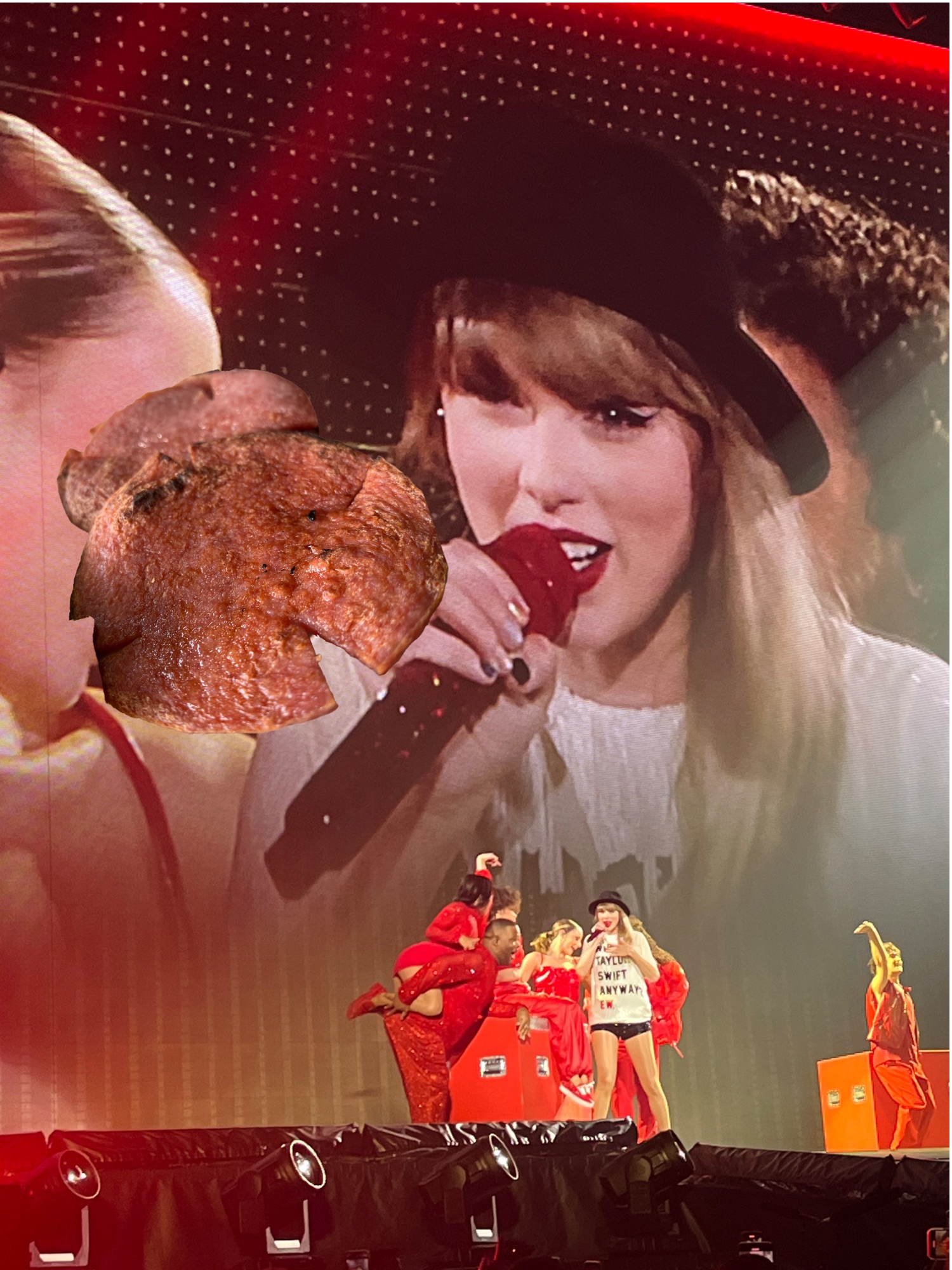

That sounds familiar, I said to myself as I got out of my car on Saturday, November 13. I had just listened to the entirety of Red (Taylor’s Version) the day prior. The song on the radio was “Message in a Bottle,” a veritable bop from Taylor Swift’s latest album, released on Friday, November 12. I couldn’t believe the radio was already playing a song from the vault, but it’s really no surprise considering the mega promotional tour Taylor is doing to back Red (Taylor’s Version).
Even before Taylor came out with her new rendition of Red, the original recording was destined to go down as one of her best albums ever. I can say that confidently even while acknowledging she has many years left to produce quality tunes. But in Red (Taylor’s Version) (hereafter referred to as Red TV), we have Taylor Swift’s greatest album of all time.
Red TV pairs the 20 tracks that had been previously released as Red (Deluxe Version) with 10 new-ish songs from the “vault,” as she likes to say. I say “new-ish” because “Ronan,” “Better Man,” and “Babe” had all been released in various forms previously. With Red TV, Taylor really does us a solid: she could have released the 10 songs from the vault as its own album and called it a day. The vault songs on their own would be catapulted into the top three albums Taylor had ever produced, by the way. Instead, with the steadfast hands of Jack Antonoff and Aaron Dessner on production, she recorded the entirety of Red (Deluxe Version) as well and gave us categorically improved versions of those tried-and-true songs from a decade ago.
In listening to Red TV, there is nuance both in the backing music and Taylor’s vocals. On “Treacherous,” a delicate ballad, the opening strum of the acoustic guitar sounds more crisp and clear than ever, while Taylor’s vocals follow in a similar vein. Much like the rest of the songs from Red (Deluxe Version), this new rendition of “Treacherous” is far superior to the ham-handed sound of the original recording.
I will say her new rendition of “22” lacks something for me, which may be the sheer vim we heard in her original recording: the sound of a 22-year-old singing about the glory of being 22. On its whole, Red TV paints a picture of a tragic love affair with an inward-looking, unavailable lover (rumored to be Jake Gyllenhaal), and I hadn’t previously pieced together that Taylor exalts turning 22 because her 21st birthday was such a disaster given her lover’s callous disregard.
Another thread I hadn’t worked out from listening to Red (Deluxe Version) but now see clearly is the shame and embarrassment Taylor felt from not being “seen” by her lover. Specifically, he didn’t think she was funny. This is an exceptional revelation—and Taylor knows it—because she is obviously hilarious. Her dry wit as evidenced by late-night talk show interviews, her quirky videos and commentary about her cats, and her live-performance banter is obvious to anyone who follows her. I’m flummoxed—but not at all surprised—by the irony of someone who carries a “fuck the patriarchy” keychain finding himself unable to believe a funny woman is funny. Just something to consider.
One last overarching observation: Taylor has said herself that Red TV has “like 14 genres” of music on it, which I think is a fair assessment. Through listening to this masterpiece of an album, I’ve realized that she doesn’t once use her “triumphant key change” on any song. You’ll recall “Love Story” and “Mr. Perfectly Fine” featuring a sudden key change in the last chorus of the song. While this type of key change is clearly a remnant from her country roots, her specific use of it has represented a turning point in the narrative, one where the protagonist (she) has finally arrived. Taylor brings out the triumphant key change on “Betty” on folklore but there’s no sign of it on any Red TV song. Perhaps this intentional omission of a familiar device is because there is no triumph in a love lost, the central theme of Red TV.
Let’s turn to the 10 stellar songs from the vault that Taylor gifted us with Red TV.
In the Rolling Stone review of Red TV, the writer argues that one or two of the album’s songs presage the narrative approach Taylor took on folklore, but I’d say that her penchant for detail and story-telling has been evident in her music from the start and is, to use a phrase, “burning red” across Red TV (“Stay Stay Stay,” “The Lucky One,” “All Too Well,” and “Starlight” are just a few examples). Taylor recorded “Ronan,” a biographical song about a four-year-old boy who dies from cancer, for a fundraiser and her gift for textured detail in songwriting is on full display. As a mother of an infant daughter, this song just hits differently for me now. I can’t help but sob from the very first stanza. Her ability to translate the human experience—one she hasn’t lived herself—is unparalleled here.
For whatever reason, Taylor originally gave “Better Man” to Lady A (lol at them stealing that name for their band, you may know them as Lady Antebellum) and not-so-secretly I think I prefer that version. In Taylor’s rendition, the slowed-down song features more flair and nuance within lines. Realizing “Better Man” is a Red era song really gave it new meaning for me.
Boy do I love “Nothing New,” and honestly I can’t believe she withheld this song from us for so long. But I’m kind of happy she did because we got Phoebe Bridgers singing on it. This simple, moody, and perfect song about the revelations of growing older and more familiar to those around her features some of the most profound lines Taylor has written. Chief among them is, “How can a person know everything at 18 but nothing at 22?” Can you believe Taylor produced that line at such a young age? Such profound wisdom rarely comes to a songwriter in their entire career much less at the beginning of it.
Sugarland originally recorded “Babe,” and I definitely prefer Taylor’s version. She sounds great and this somehow upbeat take on a melancholy topic could be a single.
As soon as I hear the first bars of “Message in a Bottle,” I can’t help but dance. This is the boppiest bop on all of Red TV; yes, I’m looking at you “We Are Never Ever Getting Back Together.” It’s crazy to me her team didn’t put this song on the original album because it could have easily been the lead single. Fast forward to 2021 and it is, I guess!
All of the vault songs on Red TV are top-notch, but this particular stretch of songs is probably the strongest. Next we have “I Bet You Think About Me,” sung with country singer Chris Stapleton. The hefty country tune draws a sharp-as-a-knife contrast between the worlds of Taylor and her lover who she paints to be an elitist (“Mr. Superior”). Her takedown of him is vicious yet I can’t stop singing along. My favorite part of the song is the outro where she goes in strong, using the literary device synecdoche when she sings, “I bet you think about me in your house with your organic shoes and your million-dollar couch” to represent the whole of the hollow poseur she sings about. I also love that she acknowledges he probably thinks “oh my God, she’s insane, she wrote a song about me” – LOL of all LOLs.
Across her ouevre, Taylor has declared 2 am as her hour of inspiration (“Last Kiss” and “I Wish You Would” are two examples), yet on “I Bet You Think About Me” and later on “Forever Winter,” she assigns 3 am as the hour to observe other characters in her songs. Something about the wee hours of the morning gets her.
“Forever Winter” is so well-written and definitely a bop, but it’s a sad story about someone who’s contemplating suicide. I hear The Beatles in this song.
“Run” is another duet with Ed Sheeran, purported to be the first song they wrote together. It’s melodic and delicate and puts their beautiful intertwining harmonies on full display. Somehow I’m reminded of a recent Harry Styles song when I listen to this one.
I think “The Very First Night” also has single potential. Instead of recalling the emotionally painful part of their love affair, this song focuses on the happy moments Taylor owes to the relationship she had with him. This one has country-pop crossover—the hallmark of Red—written all over it.
Last but certainly not least is “All Too Well (10 Minute Version),” which is being called Taylor’s “magnum opus.” There are a lot of reasons why that’s the prevailing sentiment about this one, and it’s evident Taylor is most proud of this song, and this specific version of the song, judging by her repeated performances of it (as well as the short film she directed which portrays on screen the vivid imagery deeply embedded in the lyrics). She said that “All Too Well” was her favorite song from this album, and despite never being a single or a song that had a video, it became regarded as her best song of all time by fans.
I’m impressed and amazed by the level of detail and cinematic quality she imbues into the new stanzas of this song. Yet I feel it’s slightly meandering, where the original “All Too Well” had a very clear narrative structure: exposition where the premise of their relationship is established; a climax where the love disintegrates (“Maybe we got lost in translation / Maybe I asked for too much / But maybe this thing was a masterpiece ‘til you tore it all up … And you call me up again just to break me like a promise / So casually cruel in the name of being honest / I’m a crumpled up piece of paper lying here / ‘Cause I remember it all, all, all too well”); and a clear denouement that’s evident in the pared-back instrumentals and lyrics focusing on picking up the pieces. In contrast, the 10-minute version walks deeper into the abyss of pain and torture her lover inflicted on her.
One of the greatest joys of listening to the “Taylor’s Version” albums so far is seeing Taylor’s songwriting process up close and personal. It’s clear she’s fascinated by certain phrases and wants to articulate them in her work. For example, on “Mr. Perfectly Fine” from Fearless (Taylor’s Version), we get her first use of “casually cruel,” which is such a sharp observation that would later make its home in “All Too Well.” On the 10-minute version of “All Too Well,” we hear her invoke Shakespeare’s “all’s well that ends well” (“They say that all’s well that ends well / But I’m in a new hell every time you double-cross my mind”). She would later bring this idea back in “Lover” but in a more positive light (“All’s well that ends well to end up with you”).
Across her albums, Taylor has called on her relationship with her dad (“The Best Day,” “Mine,” and “cardigan,” among others), but it’s on this 10-minute version of “All Too Well” that we get his voice: “But then he watched me watch the front door, willing you to come / And he said, ‘It’s supposed to be fun, turning 21.’” I find it interesting that Taylor chooses to bring her father into the song, rather than her mom, with whom she has a strong and deep relationship. This feels intentional as a means to illustrate the power grab her lover forged by winning over her father—and everything that goes with that—early in their relationship.
Some of Taylor’s greatest lyrics occur across this song. Among my favorites is
And there we are again, when nobody had to know
You kept me like a secret, but I kept you like an oath
And then there’s the final verse, which is radiant in its brilliance:
And I was never good at telling jokes, but the punch line goes
“I’ll get older, but your lovers stay my age”
From when your Brooklyn broke my skin and bones
I’m a soldier who’s returning half her weight
And did the twin flame bruise paint you blue?
Just between us, did the love affair maim you, too?
‘Cause in this city’s barren cold
I still remember the first fall of snow
And how it glistened as it fell
I remember it all too well
Red TV is an incredible feat of songwriting and I’m so glad Taylor gave it to us.
 Taylor's Ham
Leave a reply to 1989 (Taylor’s Version) | Taylor's Ham Cancel reply